The loop, described plainly
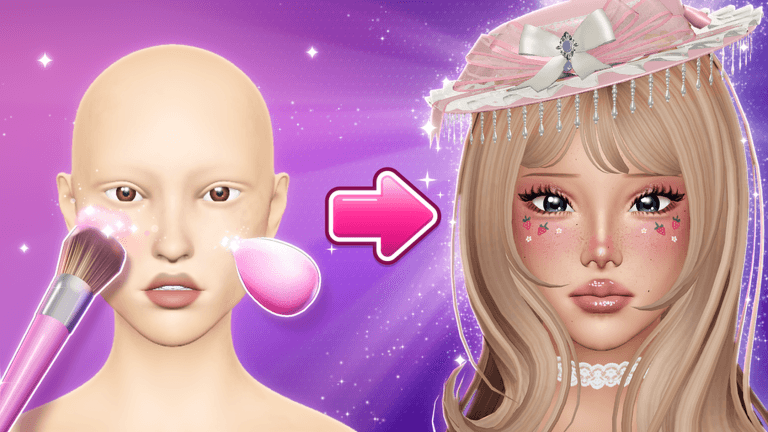
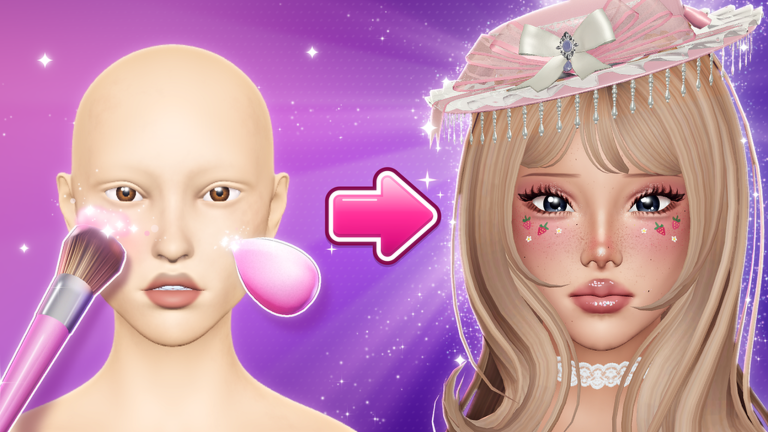
Strip away the promotional language and Facecard: Makeup Showdown is a prompt-based creative competition. You open the experience and land on a blank face. From there you work with brushes, foundation, eyeshadow, lipstick, hairstyles, lashes and rhinestones, building a full look from scratch rather than picking a pre-made avatar style. The official description frames this as being a makeup artist who perfects a dream look with various tools and makeup.
In the main mode, the sequence is short and repeatable. You are given a theme, you get a set amount of time to nail it, and then everyone votes on the results. That is the whole spine of a round: read the prompt, apply products and accessories, submit before the clock runs out, and sit through a community vote. Freeplay is the second entry point, and it is the same toolset with the clock removed, so you can experiment at your own pace with no theme to satisfy and no peers judging the outcome.
The Shop button sits on the right-hand side of the screen, so anything purchasable is one click away during a session rather than buried in a menu.
Session one versus session twenty
The first few rounds carry a lot of natural momentum. Everything is new: the order you layer foundation and shadow, how the lashes read from a distance, whether rhinestones help or clutter a look, and how a theme pushes you toward a color story you would never pick yourself. The timer does real work here, forcing decisions instead of letting you polish forever.
Where the novelty thins is in the surface area of the toolset itself. The same brushes, hairstyles and lash options are available every time, so by a twentieth session the variation has to come from two places: the theme you are handed and the looks other players submit. Neither of those is under your control. When a theme lands in your comfort zone, rounds can feel like executing a familiar recipe; when it does not, the round either produces a genuinely different look or a rushed one. Freeplay does not solve this, because it removes exactly the pressure that makes the main mode interesting.
There is also no stated progression ladder in the research: no levels, ranks, unlock tracks or currency earn rates are documented for this experience. Progress, such as it is, reads as social rather than systemic. You improve at reading themes quickly and composing under time, and your reputation is whatever the vote returns that round.
Progression pacing against the content actually available
Because no unlock schedule or reward curve is documented, pacing has to be judged structurally. The available content is two modes, a theme prompt feeding the competitive one, a shared toolset of makeup and styling items, and a Shop entry point on the right side of the screen. Against that inventory, the game leans almost entirely on theme variety and player-facing votes to generate new experiences. If you are the kind of player who needs visible meters climbing to feel like a session mattered, this loop offers little of that by design. If you treat each round as a small creative brief with a social payoff, the same emptiness reads as room to breathe.
Update culture is worth noting here too. There is no official Facecard: Makeup Showdown wiki or Trello board, so the Roblox group for the experience is the documented channel for following the developers and the latest updates. That means players who want to know what changed have one place to check rather than a changelog archive.
What it borrows, and what it adds
The theme, timer, vote structure is a familiar shape in creative competition games: a shared brief, a deadline, and a crowd verdict. That format is the genre's standard way of turning solitary creation into a spectator event, and Facecard: Makeup Showdown adopts it without complication.
What it adds is a specific craft vocabulary. The emphasis on stacked lashes, rhinestones, hairstyles and a full face of products gives the creation step more granularity than a generic dress-up prompt, and the official framing of a lethal facecard that wins votes ties the toolset directly to the scoring moment. Freeplay is the other deliberate addition, an explicit no-stakes sandbox for players who find the clock hostile.
Who this loop satisfies
Social players get the most out of it. The round only resolves when everyone votes, so the payoff is a room of people reacting to your face.
Creative players who like briefs come next. A theme plus a deadline is a small commission, and players who enjoy working inside constraints will find the main mode comfortable.
Checklist players and optimizers are the weakest fit. With no documented stat system, ladder, or reward rates, there is nothing to min-max beyond your own speed and taste, and the vote is a popularity read rather than a calculable score.
FAQ
Q: What actually happens in a round of Facecard: Makeup Showdown?
You start on a blank face, receive a theme, and get a set amount of time to build a look with brushes, foundation, eyeshadow, lipstick, hairstyles, lashes and rhinestones. When the round ends, everyone votes on the submitted looks and the best facecard wins.
Q: How is Freeplay different from the main mode?
Freeplay gives you the same makeup and styling tools with no clock ticking and no theme to satisfy. It exists for experimenting at your own pace, while the main mode is the timed, voted competition.
Q: Are there any codes to redeem in Facecard: Makeup Showdown right now?
There are currently none to redeem. This page is monitored and updates the moment codes drop, and no rewards can be claimed yet for Facecard: Makeup Showdown.
Verdict
Facecard: Makeup Showdown is honest about what it is: a timed prompt, a detailed makeup kit, a vote, and a Freeplay safety valve. Its strength is the crispness of that round structure and the specificity of its tools, from foundation layers down to rhinestones. Its weakness is thinness around the edges, since variety depends on theme draws and other players, and no progression system is documented to carry long-term goals. It will satisfy players who want a quick creative competition with a social verdict and frustrate anyone hunting for a grind with visible returns. Play it for the rounds, not for the ladder.
Facecard: Makeup Showdown Codes (November 2026)
No active codes yet for Facecard: Makeup Showdown; 6 unverified codes are being tracked.
Not yet fully verified. This list updates as sources are rechecked.
No verified active codes are currently recorded for this game. 6 community reported codes are awaiting verification in the Unverified Reports list below, with the source and date we recorded where available.