What you actually do, minute to minute
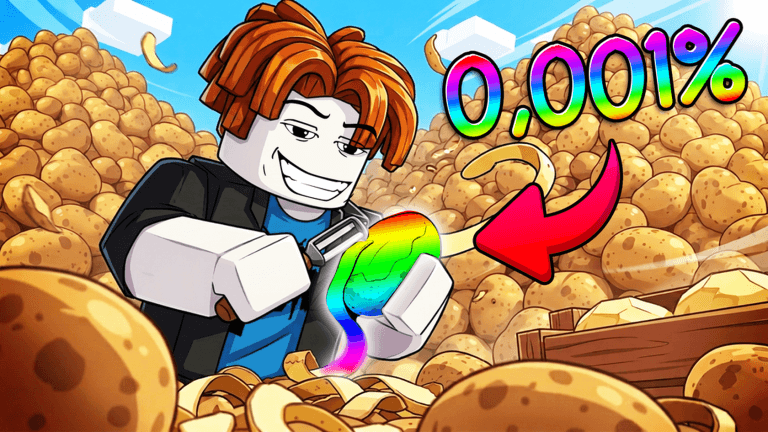
Strip away the storefront framing and Peel THE Potato is a very small number of actions repeated on a tight rhythm. You pick potatoes from the pile, you sell what you have collected, then you spend the money on upgrades that let the next round of picking and peeling go faster. The menu work happens from the Tab screen, where pickup upgrades and peeler improvements live, and the tools break down into two clear pieces: a Hand Peeler that you crank, and an Auto Peeler that runs on its own once it is paid for and upgraded.
That loop is the whole spine. Everything else in the game hangs off it as either a multiplier on the loop or a side objective that pulls you away from the pile for a while. Understanding whether the game is for you mostly comes down to whether the repetition feels like a treadmill you resent or a rhythm you find comfortable.
Session one versus session twenty
The first session has a lot of small wins. Money comes in, the Tab menu offers something to buy almost immediately, and the difference between your first pick and your tenth is visible without any guide. The Hand Peeler giving way to an Auto Peeler is the clearest early milestone, because it changes what your attention is spent on.
Session twenty is where the honesty matters. The pick, sell, upgrade cycle does not fundamentally change shape as you go, so the novelty has to come from the systems layered on top rather than from the core action itself. That is where the hidden key hunt and the vault escape become important: they give you a finite goal that is not just another bigger number, and community walkthroughs for the game treat the key hunt as a real step-by-step affair rather than a footnote. The badge set works the same way, with key hunting, vault escape, mutation finds, and milestone badges all tracked as separate chase items.
The honest read is that the loop thins out at a predictable point, and players who need a genuine mechanical reinvention every few hours will feel it sooner than players who enjoy tuning a machine until it runs clean.
Progression pacing against the content that exists
Progression in Peel THE Potato runs on two tracks. The first is money and upgrades, which is a smooth curve with no cliff visible in the sources reviewed. The second is the Class roll, which is a lottery rather than a shop.
The class odds that have been documented break down like this. Peasant is the default class at a 50 percent drop chance and carries no bonuses. Comrade drops at 20 percent and increases money earnings by 5 percent for each player on your server, capped at 15 percent. Digger sits at 15 percent and adds one potato to every pick, an effect that stacks with the pickup upgrades available in the Tab menu. Mechanic drops at 12.5 percent, halves the cranks required by Hand Peelers, and doubles Auto Peeler speed.
Beyond those sit Potato Expert, which adds 25 percent to every potato sold, and Hero of the Potatoes, which is effectively the full package in one roll: one extra potato per pick, machines running twice as fast, a 25 percent sell price bonus, 5 percent money per server player, and 20 percent faster pickup.
Read together, these numbers tell you something useful about pacing. The gap between a Peasant and a Hero of the Potatoes is enormous, and because classes are rolled rather than purchased, a lot of your real progression speed is decided by luck rather than by planning. Optimizers will feel that tension immediately.
What it borrows, and what it adds
Peel THE Potato is transparently built on conventions the Roblox simulator and tycoon audience already knows: a sell point, an upgrade menu, machines that replace manual effort, and a money number that goes up. None of that is novel, and pretending otherwise would be doing the game a disservice.
What it adds is a bit more distinctive. The vault escape and hidden key hunt inject a light puzzle and exploration layer into a genre that usually has none, and the mutation finds plus pet and character roster give collectors something to chase that is not purely economic. Badges are spread across those systems rather than handed out for raw playtime, which is a better design than most games in this bracket manage.
Who this loop actually satisfies
Checklist players have the most to work with here, between the badge categories, the key hunt, and the mutation collectibles. Optimizers will enjoy the class roll and the way Digger stacks with Tab pickups, though they will also be the first to complain about roll variance. Social players get a genuinely interesting hook from Comrade, which rewards being on a populated server rather than playing alone, and Hero of the Potatoes extends that same server scaling.
On monetization and codes
The sources reviewed for this piece do not document the Robux storefront or specific purchase pricing for Peel THE Potato, so any claim about price points would be speculation. What can be said plainly is that there are currently no rewards to redeem. Peel THE Potato has no codes tracked at the moment, and this page is monitored so that when new ones drop they will appear in the live list. Codes in Roblox generally expire quickly once distributed, which is why redemption should not be treated as a reliable progression strategy.
FAQ
Q: Which class should you take first in Peel THE Potato?
The evidence reviewed does not crown a single best class. Comrade is the safest early pick because it scales with the number of players on your server up to a 15 percent cap, while Digger is attractive because its extra potato per pick stacks with the pickup upgrades in the Tab menu. Hero of the Potatoes combines every major perk but comes from the same roll pool, so you cannot plan around it.
Q: Does the vault escape and hidden key hunt matter to progression?
Yes, as far as community walkthroughs describe them. The hidden key hunt is treated as a step-by-step objective that leads into a vault escape, and the badge list treats key hunting, vault escape, and mutation finds as distinct chase categories, so they are more than decoration on the core peeling loop.
Q: Are there any codes to redeem for Peel THE Potato right now?
No rewards can be claimed yet. There are currently none to redeem, and this page will update the moment the developer releases something.
Verdict
Peel THE Potato is an honest, unpretentious grinding loop with a thin but real exploration layer stapled to it. The pick, sell, upgrade rhythm will satisfy players who like optimizing a machine, and the key hunt and badges give checklist players reasons to keep opening the game. The class roll is the design's sharpest edge, since a big chunk of your power is decided by variance rather than effort. It is best approached as a comfortable rhythm game with collectible side goals, not as a system that will reinvent itself for twenty straight sessions. For that audience, it is worth playing. For players who need constant mechanical reinvention, wait for a bigger update before committing.
Peel THE Potato Codes (October 2026)
No active codes are available right now for Peel THE Potato.
Not yet fully verified. This list updates as sources are rechecked.
No verified active codes are currently recorded for this game.